
Heritage Recognition and Protection in Newfoundland and Labrador
To understand the heritage landscape in Newfoundland and Labrador, start by separating recognition from protection. A plaque, a listing, or a national title tells the world a building matters. Protection is more complicated. It depends on three things: where the building stands, how it has been recognized, and the people who care for it.
Rules and recognition are set at the local, provincial, national, and international levels. This guide brings those layers together in one place, because knowing which rules apply to your building is the first step toward caring for it well.
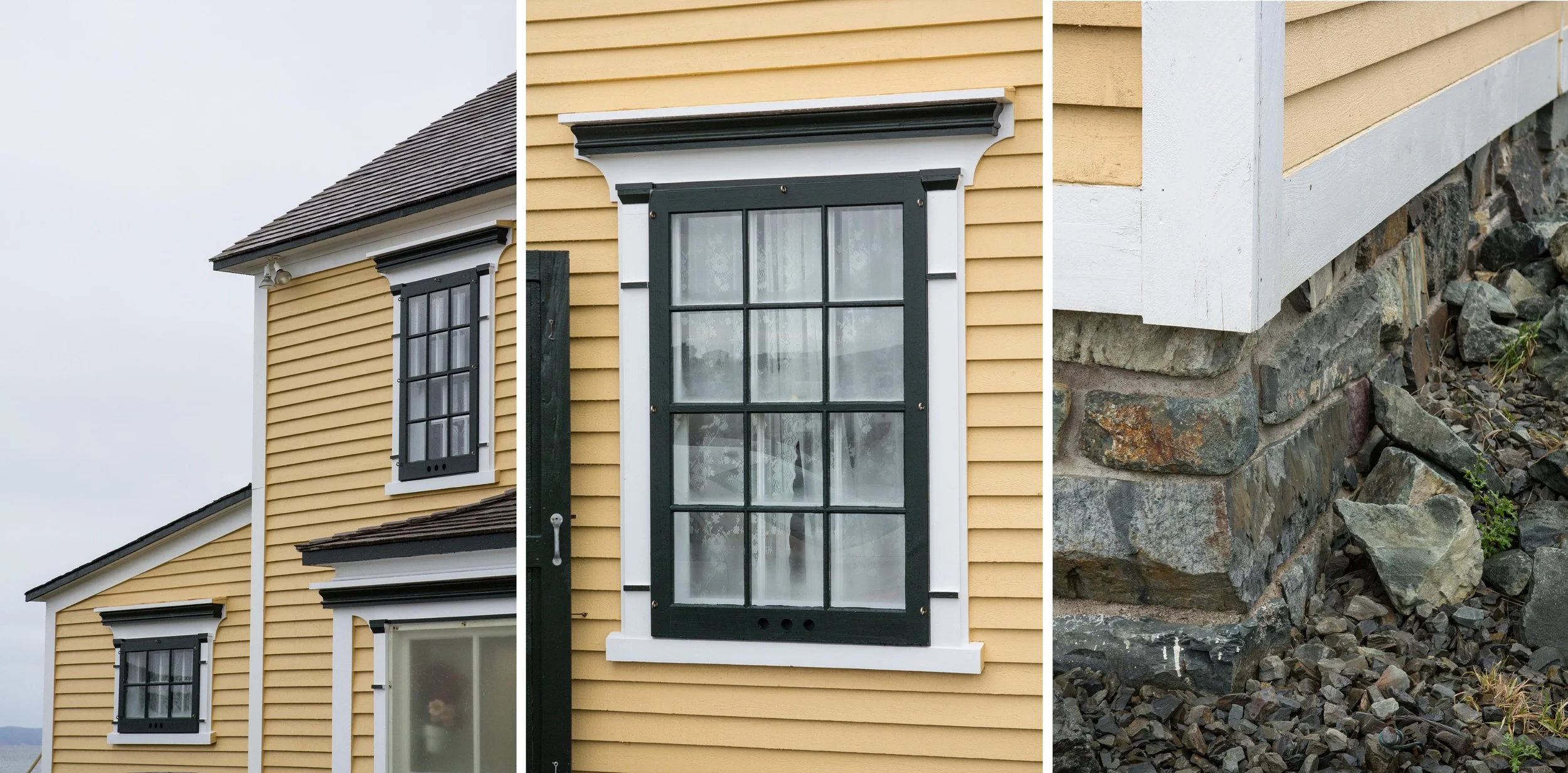
Restoration of a heritage residence on the Bonavista Peninsula, highlighting construction details that are character-defining elements.
Levels of recognition at a glance
| Level | Type | Who is responsible | What it does for a building | Examples in NL |
|---|---|---|---|---|
| Local | Cities | City councils | Designates Heritage Buildings and Heritage Areas, and reviews exterior work and demolition | St. John's Heritage Areas |
| Towns and Local Service Districts | Town councils and local service district committees | Local heritage by-laws or policies, if in place; provincial and national protections may also apply | Bonavista's Heritage By-Law | |
| Unincorporated Communities | Owners and communities | No local government; provincial and national protections apply | — | |
| Provincial | Built Heritage | Heritage NL | Designates Registered Heritage Structures and Districts; grants come with conservation policies | Thimble Cottage, Temperance Street Houses, Glynmill Inn |
| Archaeology | Provincial Archaeology Office | Protects archaeological sites, artifacts, and fossils everywhere; work needs a permit | Applies on all land, including private land | |
| National | National Historic Sites | Parks Canada | Recognizes national significance; Parks Canada cares for the sites it owns | Signal Hill, Cape Spear |
| Lighthouses and federal buildings | Parks Canada and federal departments | Protects designated heritage lighthouses and federal heritage property | Cape Race, Point Amour | |
| International | World Heritage Sites | UNESCO | Recognizes world significance; protection comes from the levels beneath | L'Anse aux Meadows, Red Bay |
Local (Municipal)
Your local council holds the strongest heritage powers in the province. Which rules apply depends on whether your building is in a city or a town.
Cities
St. John’s has the most comprehensive rules in the province. Its Heritage By-Law (By-Law 1642, passed in 2021) sets out four Heritage Areas and a list of designated Heritage Buildings. It uses a design guide approach, where exterior work is checked against standards written for each area. For example, vinyl siding is not allowed on a designated Heritage Building or anywhere in Heritage Area 1, and wood clapboard has a traditional size. In Areas 2, 3, and 4 (the Battery), vinyl is allowed if it matches the building’s original look. In every area, street-facing windows are single or double hung, about half as wide as they are tall.
A proposal to demolish a designated Heritage Building goes through a full review. Council sets what a Heritage Report must cover, including the building’s heritage value and the effect of the proposed work. The public is consulted, and the City can ask its Built Heritage Experts Panel, a volunteer group of architects, contractors, historians, and planners, for advice.
The province’s other two cities, Mount Pearl and Corner Brook, have their own policies.
Towns and Local Service Districts
Outside the three cities, each town approaches heritage in its own way. Since January 1, 2025, the Towns and Local Service Districts Act has given every town council the power to designate heritage buildings, structures, and land by by-law. Once a council does, section 188 protects that property from demolition and new building, and any change to its exterior needs a written council permit. These rules are stricter than those in the Municipalities Act, 1999, which the new Act replaced, and heritage by-laws passed under the old Act remain in force.
The Act also covers local service districts, run by elected committees that look after services such as water, roads, and fire protection. Heritage designation is a power of town councils, so in local service districts, protection comes from the provincial and federal levels.
Bonavista shows what this looks like in practice. Its Heritage By-Law, in place since 1999, lets council designate Heritage Areas and individual historic properties. Demolishing a building in a Heritage Area, or changing the exterior of a designated property, needs a council permit, and every application goes first to the town’s Heritage Advisory Committee. Where St. John’s sets rules on materials, Bonavista’s committee can use the town’s Historic Townscape Management Plan as its guide. The by-law sits alongside the town’s municipal plan and development regulations, all published on its website.
If your town wants to start, Heritage NL’s Municipal Outreach program can help, with sample regulations, research on possible sites, and advice on setting up a heritage advisory committee.
Unincorporated Communities
Many communities in the province have no local government at all, and protection is mostly covered by the provincial and federal levels. In these communities, more than anywhere, a building’s future rests with the people who care for it.
Provincial
The Historic Resources Act of Newfoundland and Labrador takes two different approaches to what stands on the ground (structures) and what lies in it (archaeology).
Built Heritage
Heritage NL designates Registered Heritage Structures and Registered Heritage Districts. Designation is voluntary and starts with the owner, examples include Thimble Cottage and the Temperance Street Houses in St. John’s, and the Glynmill Inn (2001) in Corner Brook. It recognizes what makes a building special and makes the building eligible for Heritage NL’s restoration and maintenance grants. Owners who receive those grants follow Heritage NL’s Conservation Policies for exterior work, both to qualify for the funding and to keep it.
Archaeology
Archaeology is protected everywhere in the province, including on private land. Any digging, disturbance, or change to a known archaeological site, artifact, or fossil needs a permit from the Provincial Archaeology Office, and artifacts belong to the province.
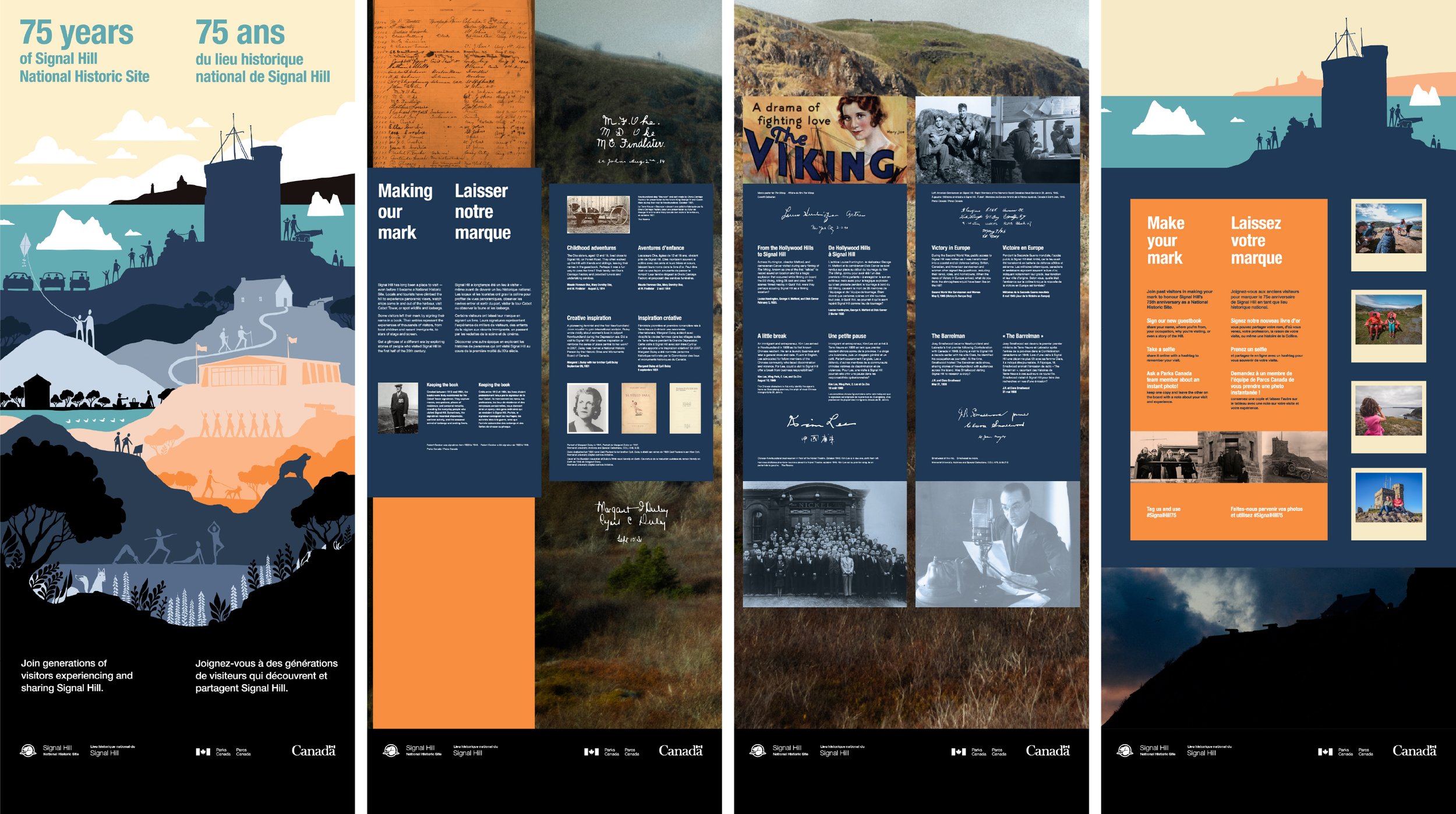
Our exhibit design with Parks Canada to celebrate the Signal Hill 75th Anniversary
National (Federal)
The federal government recognizes heritage in several ways, and each carries a different weight. Parks Canada lists them all in its Directory of Federal Heritage Designations. For context, Canada is the only G7 country without a general federal law to protect its heritage places. The Historic Places of Canada Act, introduced in 2022, would have protected the historic places the federal government runs, but it stalled and died on January 6, 2025. As of this writing, it has not been reintroduced.
National Historic Sites
National Historic Sites are recommended by the Historic Sites and Monuments Board of Canada and recognized through Parks Canada. Important people and events are recognized the same way, usually with a plaque. Where Parks Canada owns the site, like Signal Hill or Cape Spear, it cares for the site directly. Many National Historic Sites have other owners. For them, the designation marks national significance. Owners that are not-for-profit groups, municipalities, or Indigenous organizations can also apply to Parks Canada’s National Cost-Sharing Program for Heritage Places for help with conservation work.
Lighthouses and federal buildings
Heritage lighthouses have their own protection law. Under the Heritage Lighthouse Protection Act, any change to a designated lighthouse follows set criteria, demolition is a last resort, and a sale only goes ahead after public notice and on terms that protect its character. Cape Spear, Cape Race, and Point Amour are all designated heritage lighthouses. Heritage buildings owned by federal departments are cared for under separate federal heritage policies.
International
UNESCO has no legal power in Canada, so World Heritage Sites are protected by the federal, provincial, and local rules beneath them. UNESCO adds recognition, as well as the attention and responsibility that come with it.
Newfoundland and Labrador’s UNESCO sites show how these layers work together. Its two cultural World Heritage Sites, L’Anse aux Meadows (1978) and Red Bay (2013), are also National Historic Sites: Parks Canada manages L’Anse aux Meadows and shares the management of Red Bay with partners. Its two natural sites are Gros Morne National Park, managed by Parks Canada, and Mistaken Point, managed by the province. And in 2020, Discovery Geopark on the Bonavista Peninsula became the province’s first UNESCO Global Geopark, a separate program that recognizes internationally significant geology.
Where to start with a heritage building
1. Find out what applies to your building
Check two things: whether your building is designated on its own, and whether it sits inside a Heritage Area or district. Heritage NL’s Heritage Property Search covers provincial and municipal designations across the province. In St. John’s, the City keeps its own list of Heritage Buildings, while other towns may have their own heritage guidelines and regulations.
2. Talk to your council early
Your council may be the most important heritage partner you haven’t spoken to yet. Before any drawings are made, ask what approvals your project will need and who reviews them. If your community has no council, start with Heritage NL.
3. Read the national standard
Good conservation work in Canada is measured against the Standards and Guidelines for the Conservation of Historic Places in Canada (free PDF). Heritage programs and review panels use it to assess proposals.
4. Bring in a heritage architect before you plan the work
The right advice at the start sets a clear strategy for the design, the approvals, and the budget. See how we work.

Matt C Reynolds NLAA, RGD, RHFAC Professional, Architect and Director, Forgather Studio
Plan your project with Forgather Studio
Every heritage building has its own mix of rules, history, and potential. Most owners get stuck on the same three questions: what the building is for, where the money comes from, and how it opens to the public.
Forgather Studio works with owners of heritage buildings that have to pay their own way, whether a trust, a business, or a town. Matt is a licensed architect, registered graphic designer, and accessibility professional, so design, identity, and accessibility come from one team. You get the architect on every call, one contract, and a plan you can take to funders and partners.
Book a 30-minute consultation with Matt for a clear first read on whether your building is viable and where the money could come from.